
What are the best radios for private investigators and surveillance teams?
Radios for surveillance teams and private investigators. One of the most critical equipment that a private investigator or surveillance operative should have is radio communications. Reliable communications are paramount when carrying out a surveillance operation and a break down of communications usually means that things will go horribly wrong. A question I’m often asked is what are the options available? This is usually asked by new operatives that are just getting into the industry or by others that have a few jobs under their belts and have realised that a mobile phone is not up to the job.
Recently I have worked with some surveillance operatives and when questioned if they have radio comms they have replied “I don’t need a radio I just usually use my phone”. When they tell me this my thoughts are instantly that the person usually works as a lone wolf or that they have never worked with a professional surveillance team.

So what’s wrong with using a mobile phone?
I will give an example of what can go wrong with a mobile phone. Let’s say you are part of a team and you are tasked with watching an address and your job is to relay to other team members when your subject exits his home address and direction of travel. Now let’s say he exits the house, jumps straight into his car and roars off. You will now need to grab your phone, unlock the screen, find your colleagues phone number and call him. He then has to grab his phone, which hopefully will be in direct view, accept the call and then you relay to him what’s happened. In this time your subject has probably long gone, never to be seen that day again!
Some surveillance operatives use the Zello app on their phone. This sounds good in theory but again, you have to unlock your phone or if it is already open you have to find the app on your phone and again the moment is lost. If you do manage to not lose your subject, Zello will be a great drain on your battery and you will be getting distracted by notifications continuously popping up on your phone and any incoming calls will shut Zello down! What you need is dedicated instant communications.
So what are your options?
When we first started at M.R.Investigations on surveillance in Coventry & Warwickshire back in 1998 we quickly realised the necessity of two-way radio communications which gave us instant communications. In the above example given, using radio communications would be far more simple and effective. You see your subject exit the house, you pick up your radio, press a button and relay what is happening. Your colleagues don’t have to be looking at the radio they will hear it instantly. Radio waves travel at the speed of light and they can react to your commentary accordingly!
Technology has advanced immensely since 1998. Back then we were using what were at the time, state of the art VHF Motorola GP300 radios, we then upgraded to Motorola GP340 radios and then as we entered the digital age we purchased Motorola DP3600 DMR digital radios. All these radios served us well but had one distinct disadvantage and that was range restrictions. To combat this we used mag mount antennas. This increased range immensely but the antennas could easily get you noticed, especially on council estates where the natives are constantly on the look out for police.
Network/POC radios.
About eight years ago we started trialling network or POC radios (PTT Over Cellular). Network radios work on 2g,3g and 4g mobile phone networks utilising the data features available on such networks. There are two options available to you with these radios you can install your providers own platform or you can use Zello. Initially we used Zello. Using Zello on a dedicated network radio is a totally different experience than using it on your phone without so many of the problems I previously described when using it on a mobile phone.
So what were the advantages and disadvantages of network radios? Firstly I will describe the advantages.
- Crystal clear voice communications.
- Increased battery life between charges when compared to a standard radio.
- Unlimited range.
- Secure encrypted communications.
I will elaborate on the above. The network radios voice clarity is the best you can get, no static noises such as hisses etc that you would get on an analogue radio when it moves out of range. The voice clarity is highlighted when we have compared to DMR radios and find ourselves constantly saying “Repeat your last”.
The battery life of the network radios are very good indeed. Reason being that it takes a lot less power to communicate to the mobile phone network than it does to push out 4 or 5 watts on a handheld conventional radio.
As the network radios work on the mobile phone network, range is not an issue, we could have an operation running in Scotland and another down in London and would still be able to talk with each other. This has the added bonus that we no longer have to use mag mount antennas and can remain discreet.
With the network radios utilising the mobile phone networks all data is automatically encrypted, making your transmissions totally secure. Yes you can have encrypted UHF/VHF radios but the encryption levels will not be as high and with encrypted digital radios, clarity over range is reduced.
Now I have described the advantages of network radios what are the disadvantages? They have one disadvantage and that is they are reliant of the phone networks. For this reason we always keep a spare UHF radio available for such scenarios. Thankfully with most of the country now covered these times are few and far between. You don’t need an expensive back up UHF/VHF radio just for a back up, just make sure its not the type sold in Argos. You could use Baofeng UV-5R radios cheap as chips on eBay and in service with armed militias all over the world. I would advise UHF over VHF as VHF is more suited to open ground and UHF cuts through buildings better.
Surveillance radios.
Unfortunately we found that Zello had some restrictions which were detrimental when using Radios for surveillance teams and private investigators, as you may well expect when you are using a free platform. One of the restrictions with Zello being if you transmit too many short messages it will prevent you from transmitting for approximately one minute. It basically puts you on the naughty step. Now this restriction meant on one live job we had a loss of our subject as vital information could not be passed when it was required. For this reason we decided to explore other options.
The Solution?
We trialled different radios from different suppliers and both worked well but in the end decided to settle on the Motorola Wave platform. We have come to appreciate the build quality of Motorola equipment over the years and the excellent audio. We were approached by Ben Wall from Forcecom in Nuneaton who had heard about our search for the ideal radios and offered us a free month long trial of four Motorola TLK100 radios on the Motorola Wave platform.
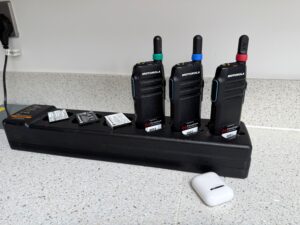
As expected the build quality was superior to the cheaper Chinese network radios that we had been using, some had developed cracks in their cases, the size of the Motorola’s was smaller and much slimmer, which made them easily concealed in a pocket. Audio was far superior compared to the previous offering we had experienced. We explored wired covert capabilities for communicating on foot, a method we had been using for some time but Ben informed us that the radios were capable of working with Bluetooth ear pods, both Apple and Samsung as well as other variants.
This was an extra bonus for us, we used to each have two radios, one for in our vehicles and one for on foot which would be in a covert radio vest with wires running under clothing for push to talk buttons and hidden mics. These could prove cumbersome and uncomfortable especially on hot days where you would find yourself sweating.
With the Bluetooth pod option we now only required one radio each which could be used in the car and when deploying on foot, slip the slim line TLK100 radio into your pocket or on a belt clip, put your pods in and voila! Instant connectivity, no discomfort, no fiddling with wires, you are good to go and look like every other Joe on the street talking into his pods! An ideal surveillance radio. Not forgetting the 256 bit AES encryption makes these radios very secure. This now frees up your phone for certain tasks such as live viewing covert footage without having to keep logging out of to pass WhatsApp messages to the team.
There is also the option of a downloadable app which has extra control features and shows GPS location of all users at any time which can be a very handy feature which I have used numerous times.
Where to purchase the radios?
We can thoroughly recommend contacting Ben at Forcecom for a no obligation trial. He offers excellent support and can make changes to your requirements over the air without any input needed from yourself to set the radios how you want them set up. These are ideal Radios for surveillance teams and private investigators
Push-To-Talk Over Cellular
Push-To-Talk over cellular is commonly reffered to as several different names. POC, LTE-PTT, WAVE, Broadband PTT to name a few. Essentially each of these names refers to the same technology which utilises WiFI and cellular (mobile) data in order to orchestrate an instant voice call.
These voice calls can be one-to-one, or one to many (referred to as a group call). Utilising WiFi and/or cellular negates the need for infrastructure and expands coverage – nationally, and beyond.
Push-To-Talk over cellular means that no call setup is required, the contact hears the call without the need to ‘answer’ or take their eyes off the job.
The technology offers superior voice/audio quality, high levels of security, advanced features and hardware based multimedia applications which can be fully integrated in to web-based dispatch solutions.
Devices are not limited to a single manufacturer, customers own mobile phones can be used if desired. However, with the ten-fold increase in new users and rapid adoption of the technology, manufacturers are now releasing specific and type approved hardware specifically for use with Push-To-Talk Over Cellular.
Motorola Solutions offering of Push-To-Talk Over Cellular is called WAVE PTX. A dedicated Broadband PTT solution providing European wide coverage. WAVE PTX is feature rich with Motorola Solutions dedicated hardware solutions and web-based dispatch options. Live video streaming, emergency/man down signalling, text messaging and location services are all possible.
Advantages of WAVE PTX –
- Licence free – no expensive, complex or time consuming licences
- Instant – communications are instant, one-to-one or one-to-many
- European wide coverage – no caps, no limits
- Choice – Use your existing mobile phones/tablets, or choose from Motorola’s WAVE hardware
- Feature rich – Mutimedia, web-based dispatch, everything on a single device